
By Dr. Brian Nel, CEO DBCon Global
There is a dangerous ritual that happens on mines every day. It is the ritual of the “Read and Sign”.
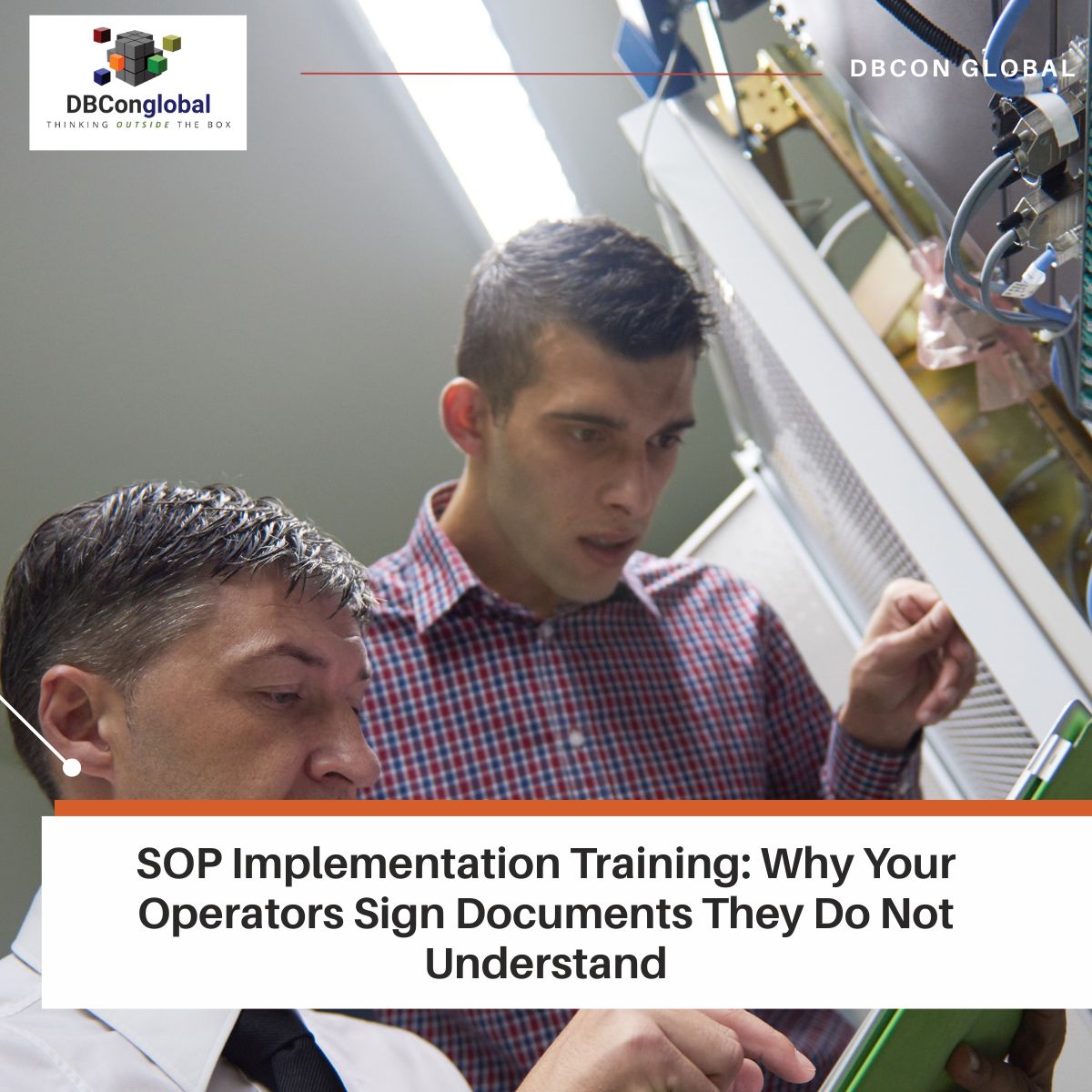
A supervisor hands an operator a new Standard Operating Procedure (SOP). The operator glances at the document, flips to the last page, signs their name, and hands it back. The supervisor files the document.
Legally, the mine is now covered. The operator has acknowledged the procedure.
Operationally, nothing has changed. The operator has likely not read the document, and if they did, they probably did not understand the technical nuances buried in the text.
This is why we see “failure to follow procedure” listed as a cause in so many accident investigations. The operator signed the paper, but they were never actually trained on the content.
At DBCon Global, we believe that writing the regulation is only step one. The most important step is SOP Implementation Training. We have to move from “Read and Sign” to “Understand and Apply”.
The Language and Literacy Barrier
We have to be honest about the South African mining context. We have a workforce with varying levels of literacy and English proficiency.
Most SOPs and technical regulations are written by engineers or lawyers. They use complex sentence structures and high-level vocabulary. When you hand a 20-page document written in academic English to an operator whose first language is isiZulu or Sepedi, you are creating a barrier to safety.
Research into industrial communication shows that when instructions are too complex, workers ignore the text and rely on “tribal knowledge” doing what the guy before them did. This perpetuates bad habits.
The Problem with the Morning Toolbox Talk
The standard method for presenting new regulations is the “Toolbox Talk”. Often, this involves a supervisor reading the new SOP out loud to a group of tired workers at 06:00 AM.
This is passive learning. The workers are listening, but they are not processing. There is no verification of understanding. There is no engagement. It is simply a box-ticking exercise to prove that the information was shared.
The DBCon Approach: Active Regulation Presentation
We treat SOP training as a specific skill set. When we develop a regulation, we also develop the training presentation that goes with it.
1. Visualisation of Regulations
We convert text-heavy procedures into visual training aids. We use flowcharts, diagrams, and photos of the actual equipment.
Instead of reading a paragraph about how to align a belt, we show a step-by-step visual guide. The human brain processes visual information much faster than text. This bridges the language gap.
2. Explaining the “Why”
Adult learners need to know why a rule exists.
Most SOPs just give instructions: “Do not open Valve B.”
Our training explains the consequence: “Do not open Valve B, because the back-pressure will cause the seal on Pump A to fail.”
When an operator understands the physics and the danger, they are more likely to respect the rule.
3. Verifying Comprehension
We do not ask “Do you understand?” The answer is always “Yes” because no one wants to look stupid.
We ask scenario-based questions during the training.
- “What would happen if you skipped step 3?”
- “Show me on this diagram where the isolation point is.”
This forces the operator to apply the information immediately.
Protecting the Employer and the Employee
This approach protects everyone.
It protects the employee from injury because they actually understand the safe work procedure.
It protects the employer and the GMR(2) from liability. If an accident occurs, you can prove that you did more than just file a paper. You can demonstrate that you provided comprehensive, understandable training on the regulation.
Conclusion
A signature on a piece of paper is not a measure of competence. It is just ink.
If you want your procedures to be followed, you have to invest in explaining them. You need to turn your SOPs into teaching tools, not just legal shields.
Do your operators truly understand what they signed?
Contact DBCon Global to discuss our SOP development and implementation training.