

By Dr. Brian Nel, CEO DBCon Global
he Fundamentals: Energy from Heat
Theory and experimentation in the 1600s and 1700s resulted in the beginnings of the understanding of thermodynamic principles. This led from the theory that heat was transferred through materials by the movement of solid particles, to an understanding that heat is a fluid state, transferred at a molecular level.
The philosopher Francis Bacon surmised it best when he wrote: “Heat itself, its essence and quiddity is motion and nothing else.”
Since these historic academic discoveries, our quest to harness the laws of physics of thermodynamics has grown exponentially. Today, it has become part of the global drive to replace Greenhouse Gas (GHG) discharge into the atmosphere.
For many years, industrial and domestic hot water was derived from using electrical power to heat elements and heat the water. As we know, this is a slow and highly inefficient process.
However, the main concern in modern times is the amount of GHG that is produced to generate the electricity required to heat the volumes of water required by the human race daily.
Today’s technology aims to produce as much heat (and cold) energy, using the least amount of carbon-generated energy. Therein lies the need for a highly efficient product which is cost-effective to install and maintain, saves on running costs, and strives towards a carbon-neutral footprint.
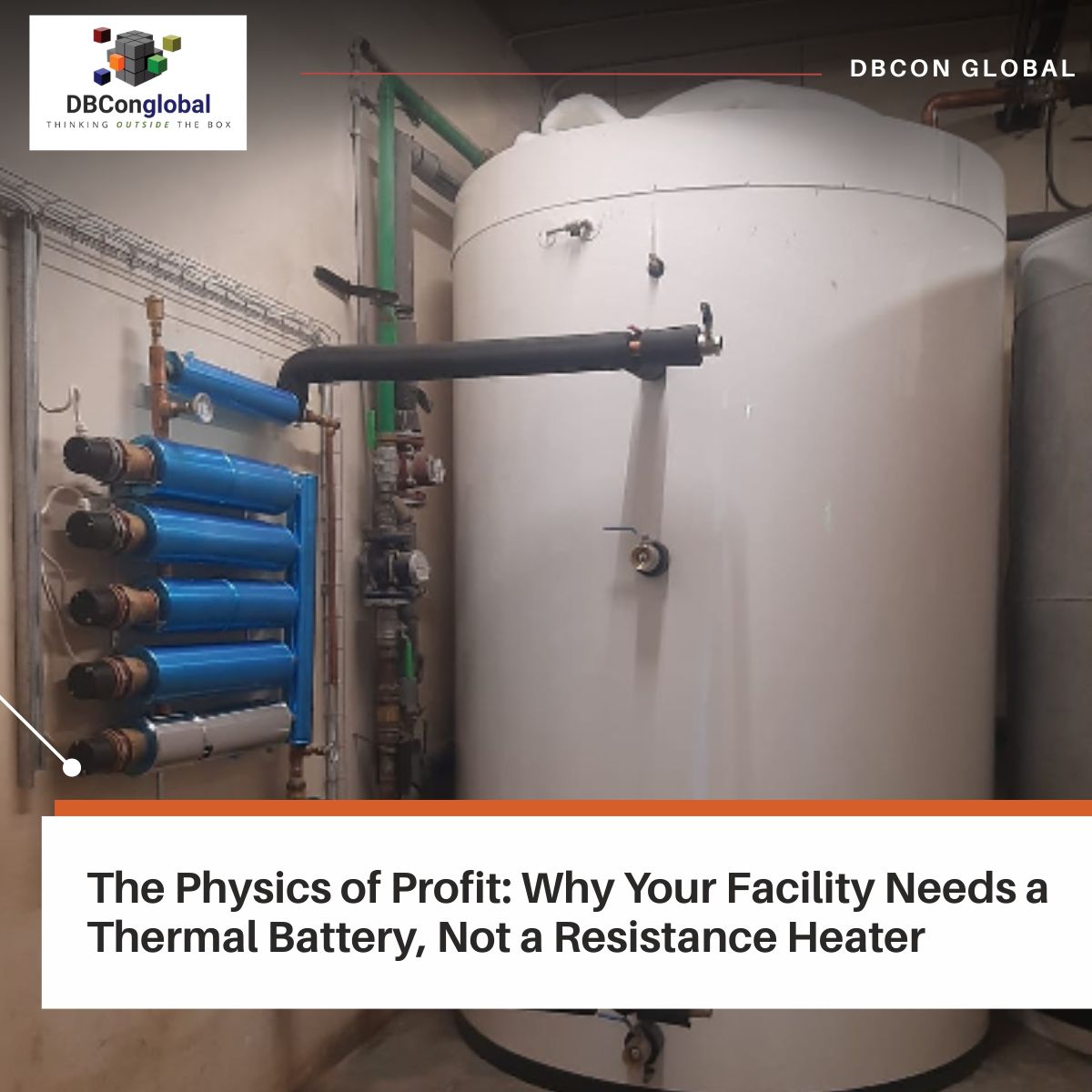
The industry requirements for such technology have become ever more insistent, and we can now say that we can supply the technology in the form of Heat Accumulators (Thermal Batteries).
The Law of Conservation of Energy
To understand why this technology works, we must look at the physics.
The Law of Conservation of Energy states that energy can neither be created nor destroyed – only converted from one form of energy to another. This means that a system always has the same amount of energy within it, unless added to from the outside (as confirmed by Émilie du Châtelet and Albert Einstein).
The critical insight for us is this: “It is how we store and use this energy that makes the difference.”
Our Market Advantage: The Technical Breakdown
At DBCon Global, we have engineered a solution that solves the regulatory and efficiency problems of traditional heating. Here is our market advantage in short:
1. No Pressure Vessel Regulations The Thermal Battery is not a pressure vessel. This is a massive operational advantage.
- There is no need for certification.
- There is no need for regular pressure testing.
- The containment unit is manufactured from glass-fibre reinforced plastic covered with a gloss finish UV-resistant Gel-Coat, making it durable and compliant without the red tape.
2. Superior Heating Methodology We have moved away from relying solely on resistive heating.
- The Thermal Battery is primarily designed to be heated by Heat Pumps.
- Heat Recovery circuits are integrated into the design where available, harvesting energy from building reticulation or HVAC systems.
- The Thermal Battery is designed to discharge heat energy (hot water) during low-demand periods to save reheating energy.
3. The “DBCon Element Bank” Backup While Heat Pumps are the primary source, we ensure reliability with a unique backup system.
- We install in-line electrical elements in the form of a unique, highly efficient electrical DBCon element bank, available in case of maintenance on the Heat Pumps.
- These banks are set to provide 10°C instantaneous Delta T.
- The capacity of one element bank is designed to equal the output of one Heat Pump, and are used unless needed.
4. Advanced Internal Engineering The internal structure is designed for maximum thermal retention and longevity.
- The He Thermal Battery exchanger coils are all internal.
- The suspended heat exchangers are fabricated from heat-treated SUS 316L stainless steel spiral tubing.
- The unit features 316 stainless headers.
- The internal coils and support structure are of the HAASE design.
5. High Performance Specs This is not a domestic geyser; it is an industrial machine.
- The rated output temperature can be set as high as 85°C.
- The interior insulation is 75mm high-density recycled plastic mat to prevent heat loss.
- The installation’s required flow rate defines the capacity of the Heat Accumulator coils at the project’s design phase.
6. Maintenance Friendly We designed it to be easy to work on.
- The Thermal Battery has a removable lid for easy inspection and access.
- It is self-filling and individually drainable to reduce water wastage.
Conclusion
We have moved past the era of simply plugging in an element and paying the bill. We are now in the era of thermodynamic management.
If you are looking for a highly efficient product that aligns with modern carbon goals and removes the regulatory burden of pressure vessels, you need to look at how you store your energy.
Are you ready to switch to a Thermal Battery? Contact DBCon Global to discuss your project requirements.