

Safety and compliance are not administrative tasks; they are design deliverables. In my 43 years in electrical engineering, powerhouse design, and large-scale program management, I have learned that safety cannot be delegated to the end of a project or to a separate department. It begins with the first schematic and continues until the system is energised and handed over. Each design produced under my supervision at DBCon Global is checked against the legal and technical frameworks that govern engineering practice in South Africa. These include the Occupational Health and Safety Act (Act 85 of 1993), the Electrical Installation Regulations (2009), the Mine Health and Safety Act (Act 29 of 1996), and the Pressure Equipment Regulations. In addition, all work is benchmarked against the relevant SANS codes such as SANS 10142-1, SANS 10108, and SANS 10292, together with ISO 45001:2018. These documents define the minimum acceptable standard; our duty as consulting engineers is to ensure that every aspect of design and execution meets or exceeds them.
Structured Risk Assessment and Digital Integration
At DBCon Global, structured risk assessment is integrated into every design phase. Three analytical methods are routinely applied: HAZOP, LOPA, and FMEA. The Hazard and Operability Study identifies possible deviations from intended parameters. Each node is analysed using guide words, and the causes, consequences, and safeguards are documented. The Layer of Protection Analysis verifies that alarms, interlocks, and shutdown systems meet the required Safety Integrity Level under IEC 61511. The Failure Mode and Effects Analysis assesses component reliability and defines maintenance intervals. All results are recorded in standardised templates and verified by discipline leads.
Risk data is managed electronically using RiskWatch and HAZOP Manager. These platforms store all identified hazards, corrective actions, and verification results. Each record lists the description, consequence, safeguard, responsible person, and completion date. Periodic progress reports are automatically generated for review by both DBCon Global and client SHEQ personnel. Collaboration with Ross Nel, Head of R&D and Technical Services, ensures that safety findings are incorporated into 3D models and schematic documentation. Under his direction, the results of the HAZOP or FMEA process are reflected in every issued-for-construction drawing, closing the gap between risk study and real-world design.
All verified actions are implemented within Autodesk Plant 3D and AutoCAD Electrical, which serve as DBCon Global’s central modelling platforms. Safety clearances, maintenance zones, isolation points, and emergency routes are annotated within the models. Hazardous area boundaries are defined according to SANS 10108, and earthing layouts follow SANS 10292. Each modification is logged under revision control, reviewed by the Responsible Engineer, and locked for issue. The use of shared model data allows construction supervision teams to run clash detection and access analyses before installation begins, reducing rework and improving safety compliance.
Example Project: Building Retrofit – Custom-Fit Hot Water Systems
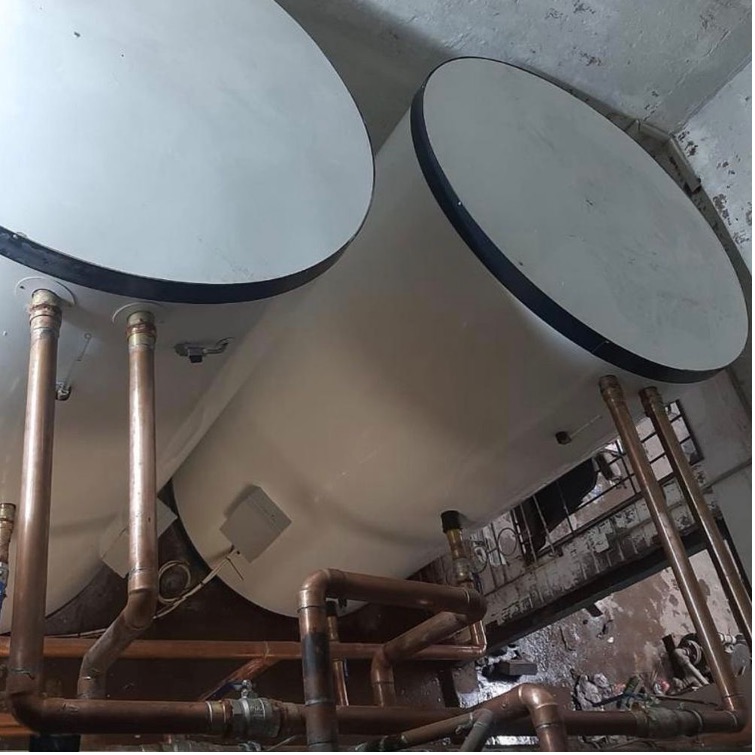
One recent DBCon Global project involved the design and installation of custom-fit hot water storage systems for a heritage building located in Johannesburg’s inner city. The existing infrastructure consisted of outdated steel tank units installed in a confined plant room with limited structural clearance. Demolition was not permitted due to the building’s heritage status, which required a retrofit solution that could be installed without altering existing walls or floors.
Our team developed a compact dual-cylinder configuration, using pre-insulated horizontal vessels coupled with copper pipe manifolds and pressure control assemblies. The system was designed to provide stable hot water delivery while remaining serviceable within restricted access zones. 3D modelling was completed in Autodesk Plant 3D, which allowed the team to simulate clearances, pipe routing, and maintenance access before fabrication.
The electrical and thermal safety controls were developed in accordance with SANS 347 and SANS 151, ensuring compliance with local pressure vessel and water heating standards. All pipework and fittings were pressure-tested and commissioned under the supervision of a DBCon Global engineer.
This project demonstrated how precision engineering, combined with accurate digital modelling and strict adherence to safety regulations, can deliver high-performance systems even in complex retrofit environments. The system continues to operate reliably, meeting both the heritage conservation requirements and the client’s daily operational demands.
Verification, Testing, and Compliance Reporting
When the design phase reaches completion, a Compliance Verification Report is compiled. This report includes the final HAZOP, LOPA, and FMEA registers with close-out evidence, calibration certificates, and certificates of conformity under Regulation 7 of the Electrical Installation Regulations. It also contains sign-off sheets from client-appointed representatives confirming compliance with the project’s SHEQ standards and with statutory requirements under the OHS Act and the Mine Health and Safety Act. Each report becomes part of the permanent data book for operational readiness, audits, or incident investigation.
During field implementation, DBCon Global engineers perform verification testing prior to energisation. Tests include insulation resistance and continuity checks in accordance with SANS 10142-1, verification of earthing integrity, relay function testing, pressure testing, and inspection of mechanical guarding and signage. Results are recorded in structured test sheets, witnessed by the Responsible Engineer, and filed under the project’s data book. These results close the loop between theoretical design compliance and physical installation quality.
From an engineering management perspective, this process ensures that safety remains measurable, auditable, and consistent across projects. Each project maintains a single traceable link between the risk register, design documentation, and as-built condition. The consistency of this method allows DBCon Global to align with auditors, regulators, and insurers because every safety measure is documented, verified, and supported by data that can withstand independent review. Engineering compliance is achieved through discipline. The objective is straightforward: identify every hazard, quantify its risk, apply a technical control, and document the outcome. That is the method DBCon Global applies on all projects.
Dr Brian Nel
Chief Electrical Engineer & Senior Program Manager
DBCon Global (Pty) Ltd